

DRAWING ACCOUNTING DEFINITION
Drawing Account is a contra owner’s equity account used to record the withdrawals of cash or other assets made by an owner from the enterprise for its personal use during a fiscal year. It is temporary in nature and it is closed by transferring the balance to an owner’s equity account at the end of the fiscal year.
The word drawings refer to a withdrawal of cash or other assets from the proprietorship/partnership business by the Owner/Promoter of the business/enterprise for its personal use. Any such withdrawals made by owner leads to a reduction in owner’s equity invested in the Enterprise. Therefore, it is important to record such withdrawals (made by the owner) over the year in the balance sheet of the enterprise as a reduction in owner’s equity and assets.
Drawing Account Entry Example
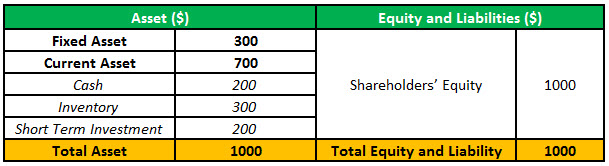
To understand the concept of the drawing account and its utility, let’s start with a practical example of a transaction in a sole proprietorship business. Assuming the owner (Mr ABC) started the proprietorship business (XYZ Enterprises) with an investment/equity capital of $1000.

The Balance sheet of XYZ Enterprises as on 1st April 2017 is as below:
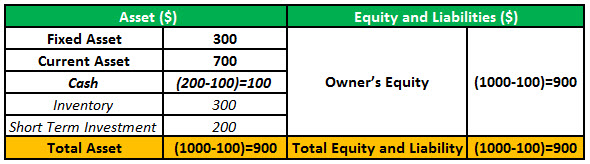
Suppose Mr ABC takes out $100 from the business for its personal use during the financial year FY18. The impact of the above transaction on the Balance sheet will be a reduction in the cash balance and in the owner’s equity capital by $100. Therefore, the Balance Sheet after the transaction will look like this:
Above demonstration is one example of a transaction, however, in proprietorship/partnership the owners generally may do multiple transactions during a fiscal year for their personal use. There is a mechanism to record such transactions and adjust the Enterprise’s Balance Sheet for such transactions where the Owner uses business resources (cash or goods) for personal use.
Drawing Account Journal Entry
Extending our discussion from initial section of the article where we have taken the example of Mr. ABC (Owner) making a withdrawal of $100 from its proprietorship business (XYZ Enterprises) for its personal use. This transaction will lead to a reduction in owners’ equity capital of the XYZ Enterprises and also a reduction in Cash Balance of the enterprise.
Since a drawing account is set up as contra owner’s equity account to record this and similar other transactions of this nature, following transactions will be recorded in drawing account. Drawing account Journal entry for the above cash transaction by owner will be recorded with a debit in owner’s and as credit in the cash account. The entries for the above transactions will be as below:

Since drawing account is a temporary account and it is closed at the end of the financial year. At the end of the financial year, the drawing account balance will be transferred to the owner’s capital account thereby reducing the owner’s equity account by $100.
Therefore, at the end of the Year owner’s equity balance will be as below:
Owner’s equity capital= (1000) +Drawing account balance = (1000) +(-100) =$900
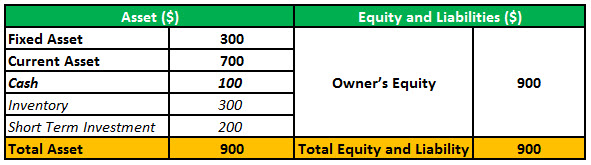
Also, Cash account on the asset side of the balance sheet at the end of financial year FY18 will reduce by $100 and a closing balance will be as below:
Cash= (200-Cash withdrawals) = (200-100) =$100
Therefore, the balance sheet position of XYZ Enterprises at the end of the fiscal year FY18 to include the impact of an above-discussed transaction will be as below
Summary of the Drawing Account Entry
Drawing account is mostly used in reference to proprietorship business or partnership business to record the owner’s drawing from its enterprise in the form of cash or other assets.
- Its a contra owners equity account to an associated owners equity account.
- It is used to record the transaction of an owner withdrawing cash or other assets from its proprietorship enterprise for personal use.
- It is temporary in nature which is closed at the end of the fiscal year and starts with zero balance to record the owner’s withdrawals in next fiscal year.
- It is closed at the end of the fiscal year by transferring the balance from drawing account to owners’ equity capital account.
- It’s useful in keeping track of distributions made to owners in a partnership business thus helps in avoiding any disputed between partners in business.
 Accounting1027